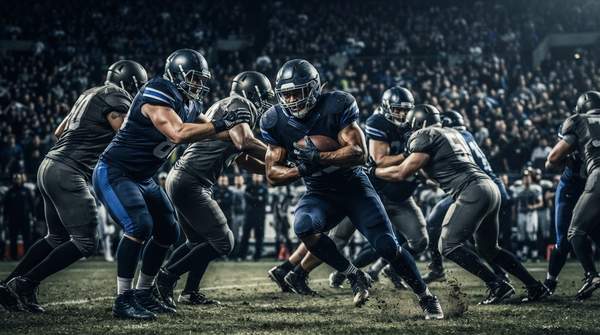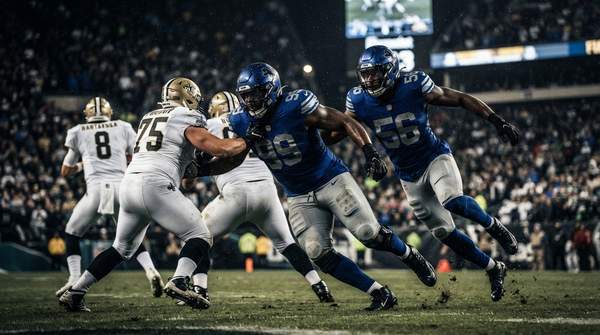
Every defensive line stunt in football, whatever its name, reduces to the same two-player bargain: one defender attacks first to occupy a blocker, and a second defender loops behind him into the vacated lane. Football Nation's guide to pass rush combinations describes the maneuver as "a coordinated movement that sends defenders through different rush lanes, often with one attacking first and another looping behind him." The aim, per that same explanation, is to force blockers to communicate and exchange responsibilities while the rush is already in motion. Understand that penetrator-looper exchange and the named games—twists, trades, T-E and E-T calls—stop being vocabulary and start being readable football.
What is a Defensive Line Stunt?
A stunt, sometimes called a twist, is a planned maneuver by a pair of defensive players who exchange roles to slip past offensive blockers at the beginning of a play, according to the Wikipedia entry on the tactic. The purpose is straightforward: confuse the opposing blockers, which aids the defense in rushing a forward pass or kick. Because the two defenders trade assignments, the maneuver is also sometimes called a "trade," and players are said to be stunting, trading, or to "have a game on"—the term has appeared in football contexts since at least the 1960s, though the maneuver itself dates to the 19th century.
Two features distinguish a stunt from other pressure tactics. First, it does not require an extra rusher: the same four defensive linemen who would rush anyway simply cross paths, which means the offense cannot identify it from personnel alone. Second, it carries a structural cost. The Wikipedia entry identifies the main weakness plainly—a stunt is more vulnerable than an average rush to the opposing team's running plays, because the crossing movement momentarily leaves gaps uncovered. That trade-off shapes when coordinators are willing to call it.
Understanding the Penetrator-Looper Dynamic
The reusable framework below deconstructs a standard two-player stunt into its sequential roles. Read it as a timeline: the penetrator's action creates the condition, and the looper's action exploits it.
| Component | What happens | Why it matters |
|---|---|---|
| Penetrator (first role) | Attacks a gap or blocker aggressively, engaging an offensive lineman directly | Draws the blocker's attention and creates a void behind the initial engagement |
| Looper (second role) | Follows around the penetrator into a different lane, often attacking from a different angle than the initial alignment | Exploits the lane the penetrator's action opened and rushes the passer |
| The exchange | The two defenders trade rush lanes as the play begins | Blockers must communicate and swap responsibilities while the rush is already moving |
| Intended outcome | A blocker takes the wrong defender or misses a block entirely | A defensive lineman gets a free rush or forces a hurried throw |
The sequence is the whole trick. The penetrator goes first and the looper goes second, per Football Nation's breakdown of the common two-player game. If both defenders moved simultaneously, blockers could simply pass off the rushers cleanly. The stagger is what turns a routine four-man rush into a communication test for the offensive line.
The Penetrator's Role: Initiating Disruption
The penetrator's job is to sell a normal rush hard enough that the offensive line reacts to him as the primary threat. He attacks a gap or blocker aggressively, and his action might involve a jab step, bull rush, or another move designed to occupy the blocker rather than necessarily to win the rep outright. What matters is not that the penetrator reaches the quarterback—often he will not—but that he fixes the blocker's eyes and feet on himself for the critical first beat of the play.
That engagement creates the void. When an offensive lineman commits his body to the penetrator, the space behind and beside that engagement becomes undefended for a moment. The penetrator is, in effect, manufacturing a lane that did not exist at the snap. This is why the role demands aggression and timing more than finesse: a half-hearted stab at the blocker leaves the lineman free to redirect to the second rusher, and the stunt dies.
The Looper's Role: Exploiting the Opening
The looper is the payoff role. He follows around the penetrator into a different lane, and he often attacks from a different angle than his initial alignment suggested—which is precisely what makes the exchange difficult for blockers to sort out. A tackle who expects the end aligned over him to rush wide suddenly finds that defender crossing inside, while another rusher loops into the space the tackle just abandoned.
Timing is the looper's hardest discipline. Leave too early and he telegraphs the game, letting linemen pass off the rush cleanly; leave too late and the pocket has already reset. In some variants, according to the Wikipedia entry, a rushing player will run around more than one rushing teammate, extending the same principle across three or more defenders. The core logic never changes: the looper's path is chosen to arrive where the penetrator's action has pulled protection away.
Strategic Purpose: Confusing the Offensive Line
Why go to the trouble at all? Because standard pass protection assumes each blocker handles the rusher nearest him, and stunts break that assumption. The purpose of the maneuver is to confuse opposing blockers, per the Wikipedia entry, and that confusion can cause offensive linemen to block the wrong defender or miss a block entirely. Football Nation's explanation frames the same goal from the defense's side: the aim is to make blockers communicate and exchange responsibilities while the rush is already moving.
That last phrase deserves emphasis. Offensive lines do practice these exchanges, and a well-drilled line can defeat a stunt with a clean pass-off. But the stunt forces that communication to happen at full speed, after the snap, against a rush that is already crossing. Even when the exchange is handled, the momentary hesitation a stunt creates can soften the edge for the rushers involved. The defense is not gambling on total confusion every time; it is buying a chance at a free rush or a hurried throw.
When Stunts are Most Effective
Situation drives the call. The American Football Coaches Association's fundamentals piece on defensive line play stresses that a defender's assignment must be understood within the game situation—field position, offensive personnel, time remaining, score, down, and distance—and that same situational reading governs when a coordinator dials up a game. The classic window is the obvious passing down, third-and-long, when the offense is expected to drop back and the stunt's known weakness against the run carries little cost.
That weakness is the balancing factor in every call. Because the crossing movement leaves gaps momentarily uncovered, a stunt called against a run-heavy look invites yards on the ground. Coaches therefore pair the call with a situational read: the more the down and distance scream "pass," the cheaper the stunt's risk becomes. Personnel matters too—an offense with extra blockers in protection can absorb a game more easily than one protecting with five.
Spotting Stunts on Game Day
When watching a game, pay close attention to the initial movements of two defensive linemen who are aligned near each other, especially on obvious passing downs. Look for one defender (the penetrator) engaging an offensive lineman directly, while a second defender (the looper) delays slightly before looping around the initial engagement into a different gap. Once you can tag those two roles in real time, the broadcast's stunt names become secondary: the penetrator-looper exchange is the mechanism underneath all of them, and recognizing it is the measurable skill that turns pass rush chaos into readable football.